Henrique Silva
Professional Solutions Specialist at AxiansRecife, Brazil
I'm a software engineer and I've worked with OutSystems since 2018. Today my work is building new solutions with AI, and new ways of working with it, inside and outside OutSystems. I also build open source apps and components.

- years with OutSystems
- 8+
- OutSystems certifications
- 9
- open source projects on this site
- 12
Projects
Things I build outside client work
Grouped by who they are for. Most of them are open source.
Open source apps
Free apps for anyone. Host them yourself, install them, or open them in the browser.
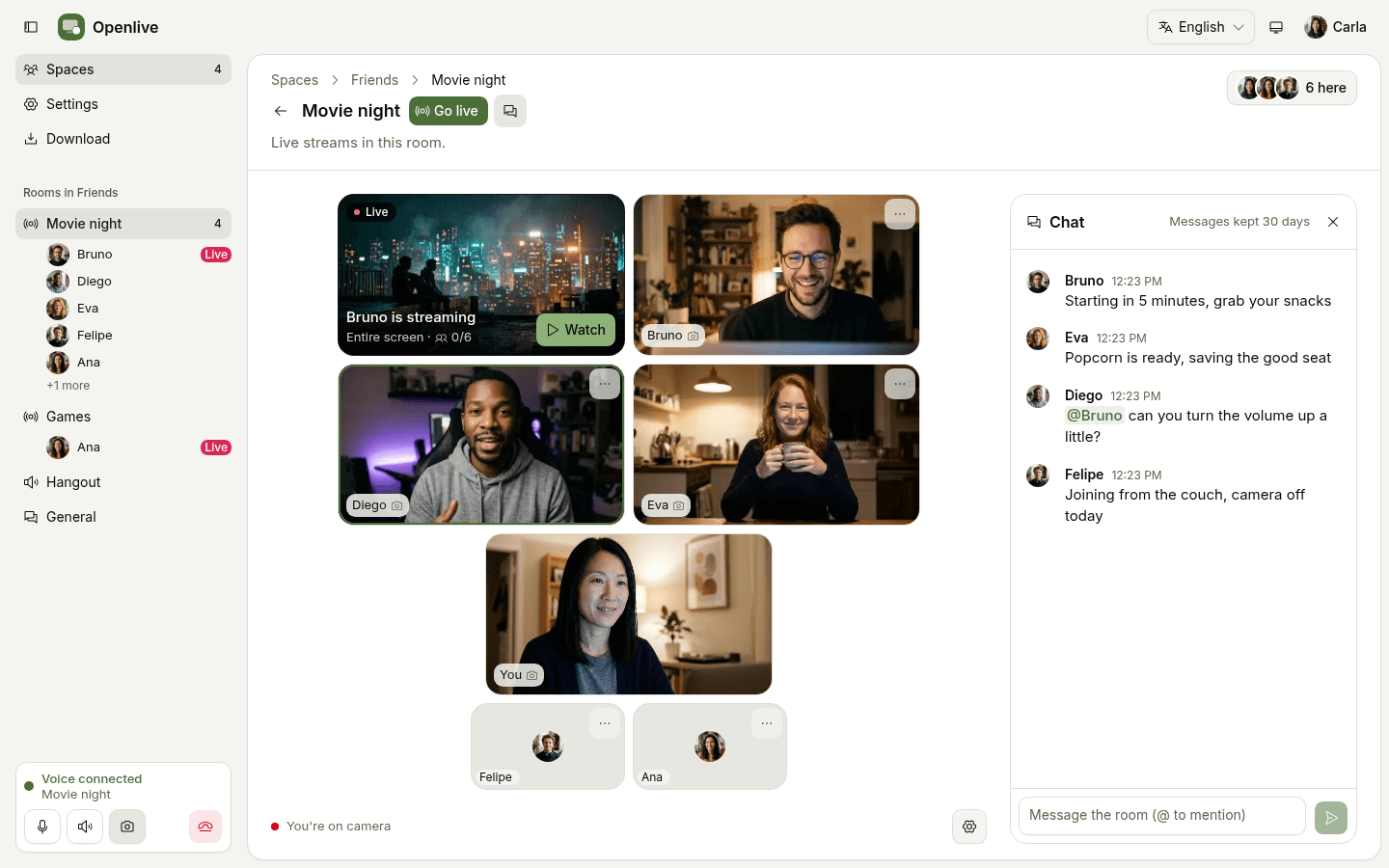
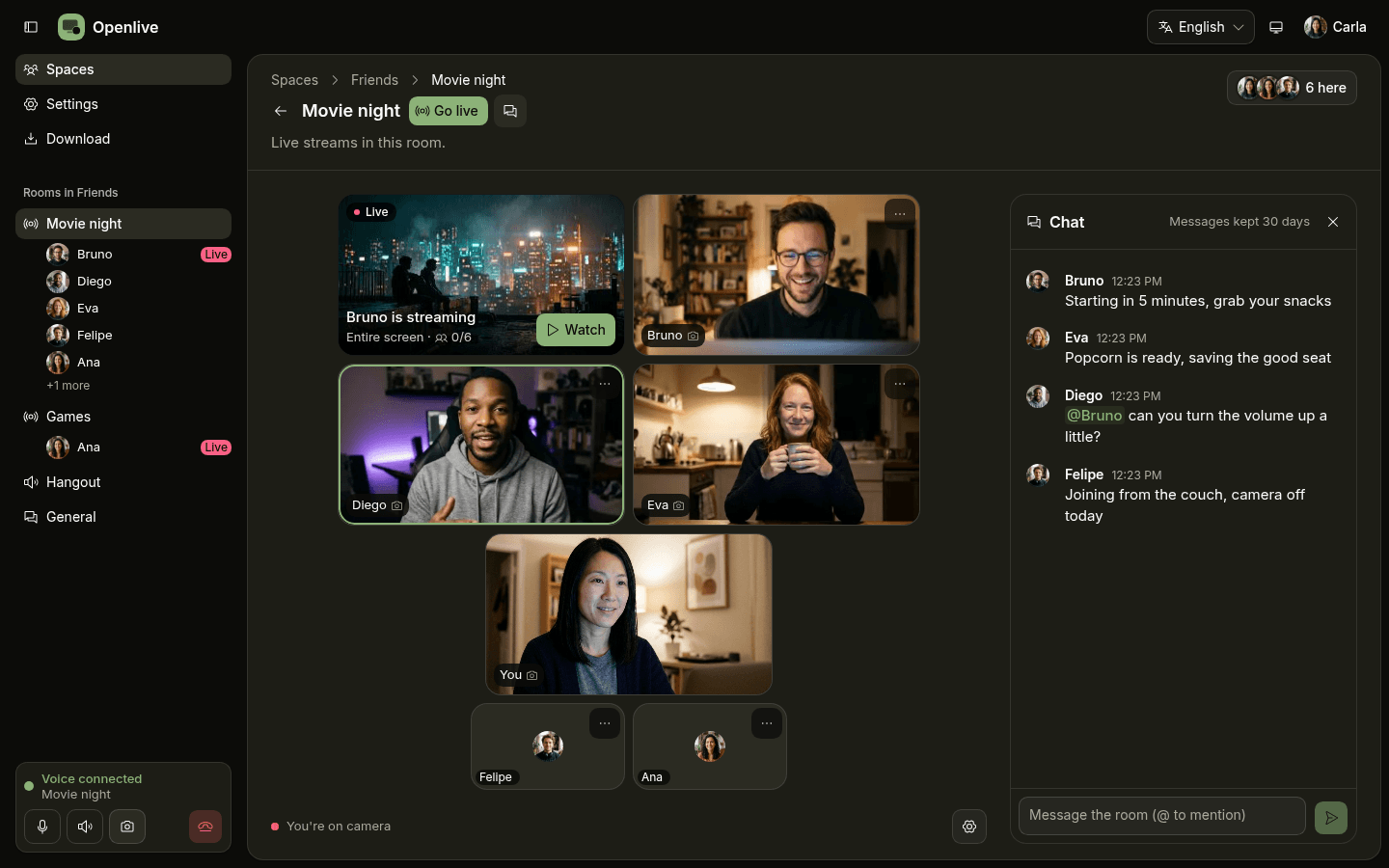
Openlive
A self-hosted alternative to Discord for groups of friends. Screen streams, voice, cameras and text, on your own Cloudflare account.
- WebRTC
- Cloudflare Workers
- Go
- React Native
- AGPL-3.0
Streams go up to 4K60, or 1440p at 120 fps, and arrive about 100 ms behind the streamer's screen. Viewers watch in the browser with nothing to install. Whoever streams runs a native helper that captures the screen with the app's sound and encodes on the GPU: Go, GStreamer and PipeWire on Linux, ScreenCaptureKit and VideoToolbox on macOS. There is also an Android app in beta, built with React Native. iOS and a Windows helper are next.
I designed the whole architecture. One Cloudflare Worker serves the app, the API and the room WebSockets. Each room is a Durable Object, and the video goes from the helper straight to Cloudflare Realtime without touching the Worker. Each group deploys its own instance with one setup command, so the accounts, the messages and the bandwidth bill are theirs.
AI made building an app possible for almost anyone. I wanted to see what years of engineering experience can build now that used to be out of reach. This is my answer so far.
Designer
An Illustrator-style SVG editor and app icon studio that runs in the browser.
Pen, pencil and brush with stylus pressure, Bézier node editing, booleans, gradients, type, and Lucide, Phosphor and Iconify icons as editable paths. Export SVG, PNG or JPG. Free, no account, and it works offline.
App icon mode draws on the platform keylines, measures the glyph as you work, fits it to the keyline and exports the whole set: Android adaptive and monochrome, iOS light, dark and tinted, favicons and the splash screen.
Optional sync keeps projects and fonts in step across your devices through a small server you run yourself. Agents get a CLI and a skill to import an SVG, fit an icon, render the set and open the project in the editor for you to finish by hand. Formerly LogoGo.
- SVG
- React
- PWA
- CLI
- AGPL-3.0
Tinta
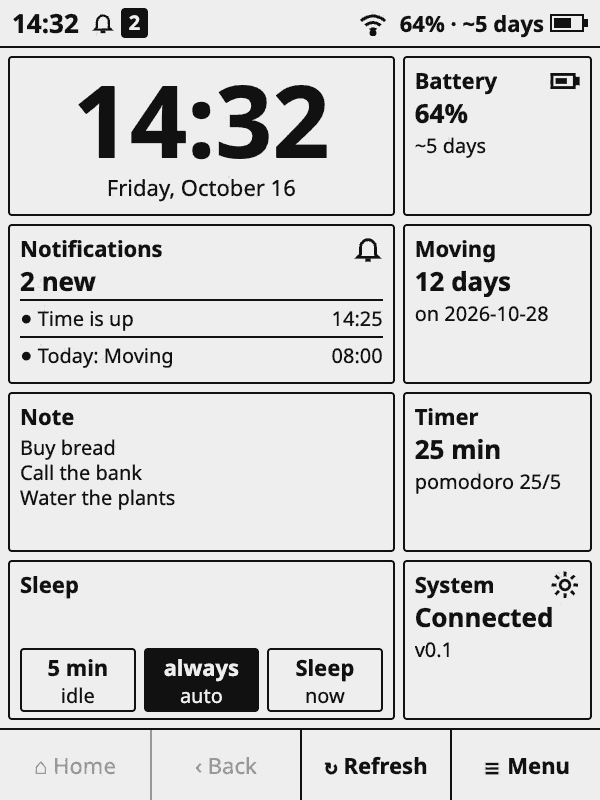
A dashboard for e-ink readers, built as a KOReader plugin.
A home screen of widgets, a notification center and a sleep page that wakes only on its clock to refresh. Black and white, no animations, made for e-ink. It runs inside KOReader, which handles the screen, touch, Wi-Fi and suspend.
Everything on the dashboard is an app, and you can write your own in a few dozen lines of Lua. Built for and tested on a Kindle Basic 2, with experimental Kobo support.
- Lua
- KOReader
- E-ink
- AGPL-3.0
Smaller tools
- QrcodeCreate and read QR codes in the browser. Nothing leaves your device.Open QrcodeGitHub
- Markdown PreviewerA Markdown editor with live preview that works offline.Open Markdown PreviewerGitHub
Developer tools
I made these to improve how I work with my AI agents. Prompts are only part of it. I also work on the setup around them: which skills they load, and how they use credentials without seeing them.
How I work with agents: Why I Stopped Letting One AI Agent Do Everything
skm
Keeps my agent skills up to date and under control.
AI makes it easy to create lots of skills. Managing them is another story, and I couldn't find a good tool for it. skm keeps my skills up to date, turns them on and off, shows how much context each one costs, and helps me decide which ones to use and which to delete. It works from the terminal or a local web UI.
- CLI
- Node
- MIT
skv
A local vault so my agents can use credentials without seeing them.
Credential leaks are a real problem. Pasting a key into an AI chat is a bad idea, and keeping keys in files inside the repo looks like a worse idea every day. skv keeps them in one encrypted file, outside every repo.
Agents use the keys without knowing their values: skv run injects them only into the command it starts, and printing values is refused for agents. That also ends the classic mistake of committing a key. Every change and use goes to an audit log, never with the values. AES-256-GCM, optional passphrase, zero dependencies. I love watching my agents use it.
- CLI
- Node
- Security
- MIT
Components
Building blocks for people making apps. Most drop straight into OutSystems.
Background Sync Plugin
A native upload queue for WebView apps. Lock the screen and the sync keeps going.
A Cordova plugin that moves the upload queue to the native layer, Kotlin on Android and Objective-C on iOS, so syncing keeps going with the app closed or the phone locked. Retries, Wi-Fi or charging-only rules, and progress notifications.
- Cordova
- Android
- iOS
- OutSystems
OLMapKit
A touch-first map component for OpenLayers.
Markers, layers from any GIS server, polygon drawing and editing with a finger, measuring, address search, import and export, printing, GPS tracking and offline maps. One script with a JSON-in, events-out API, ready to wrap as an OutSystems component.
- OpenLayers
- OutSystems
- MIT
OpenForms
A dynamic form builder and renderer that runs anywhere.
A drag-and-drop form designer paired with a reactive form player, in vanilla JavaScript with zero external dependencies. Accessible to WCAG 2.1 AA, free, and open source under Apache-2.0.
- Vanilla JS
- WCAG 2.1 AA
- Apache-2.0
DB Inspector
A read-only SQLite inspector that runs inside your mobile app.
A Cordova plugin that opens a native screen to browse any SQLite database in the app sandbox, with a visual query builder, SQL editor and saved presets. Works on Android and iOS, in Cordova, Capacitor and OutSystems apps. A web version opens .db files in the browser without uploading them.
- Cordova
- SQLite
- Apache-2.0
AnyViewer
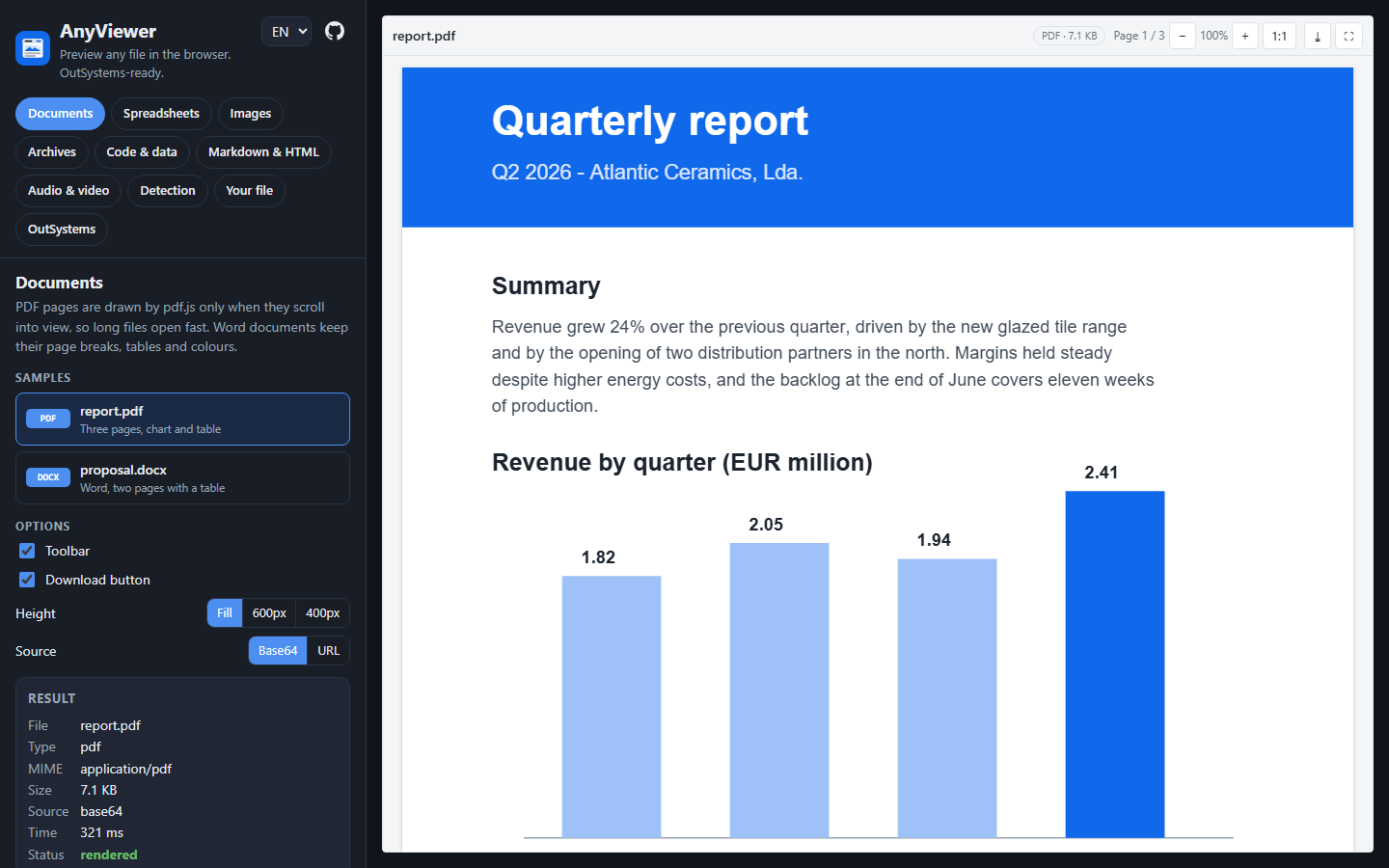
A document previewer that runs in the browser.
PDF, Excel and CSV, Word, ZIP, images, code, Markdown, HTML, audio and video. One script that loads each library only when a file needs it, ready to use as an OutSystems block.
- Vanilla JS
- OutSystems
- MIT
Personal projects
Made for myself first.
Korean Stories Daily
Tiny animated stories for learning real Korean.
I'm learning Korean, so I made the material I wanted: short conversations at a restaurant or a pharmacy, animated, with the key words as picture cards. My own pipeline turns the audio into flat-illustrated videos. New stories go out on Instagram and YouTube.
- Animation
- Korean
- Video
Work and skills
OutSystems, and the code around it
I've worked with OutSystems since 2018, on O11 and ODC. Most of my time goes to the parts the platform doesn't cover on its own: offline sync that has to survive a bad network, and AI agents that run in production, not only in a demo.
When a project needs something the platform can't do, I write it in regular code and plug it back in. I came to OutSystems with a Computer Science degree (UFRPE, 2021), and I never stopped writing code.
I'm often the first at Axians to put a new tool to work. Then I make the material that gets everyone else there: slides, videos and guides that take developers who have never used AI to using it on real tasks.
Certifications
9 OutSystems certifications. Next up: ODC Expert.
- Agentic AI SpecialistApr 2026
- Web Developer Specialist (ODC)Apr 2026
- Web Developer Specialist (O11)Apr 2026
- Architecture Specialist (ODC)2024
- Mobile Developer Specialist
- Associate Traditional Web DeveloperJul 2019
The three April 2026 exams were in the same week.
AI in production
I built and delivered an AI chatbot for a public sector client in the EU, open to end users. It follows the EU AI Act: data processing zones, retention rules, prompt-injection guardrails, and token limits that keep cloud costs in check. The client maintains it now.
Project delivery
Public sector, industrial field audits, food industry and logistics. Clients in North America, Europe and Latin America, from the first architecture sketch to production.
Mobile
OutSystems mobile end to end: app builds, offline sync for field audit apps that run for days without a network, local storage limits, and native Cordova plugins written from scratch, from HealthKit and Zoom to a background sync plugin that moves heavy uploads out of the WebView.
Languages and data
Python, Java and C from university. Kotlin and Objective-C for native plugins, C# for .NET extensions, plain JavaScript for components that run anywhere, and Python services with FastAPI. SQL Server, PostgreSQL and MongoDB on the data side.
Cloud and daily tools
Supabase, Google Cloud Run, Cloudflare and Azure: enough to design, deploy and secure an app on my own, though I don't run infrastructure at massive scale. I build with Claude Code and Google Antigravity every day.
Career
Eight years at Axians
Same company since my internship in 2018, four roles, dozens of clients.
Professional Solutions Specialist
Axians · Mar 2025 to now
On the internal innovation team. I built an AI chatbot for a public sector client in the EU, put it into production and handed it over to the client. I also designed the offline sync architecture for industrial field audit apps and wrote the native background sync plugin. I'm a technical reference for delivery teams and run internal training on AI-assisted OutSystems development.
Solutions Specialist
Axians · Mar 2022 to Mar 2025
System architecture, integrations with external platforms, and custom code where the platform stopped. Web and mobile projects for food industry and logistics clients.
Solutions Developer
Axians · Sep 2020 to Mar 2022
Built and maintained enterprise apps, learned the platform in depth, and started on deeper API integrations and custom frontend code.
Junior Solutions Developer (intern)
Axians · Sep 2018 to Sep 2020
Where it started: OutSystems 11 from the ground up, data modeling basics, and turning business requirements into working software.
Talks and writing
What I share
OutSystems ONE '26 · Amsterdam · June 2026
Monitoring AI agents in production
AI agents are hard to debug. You can't step through an LLM's reasoning the way you step through normal code. In this session I showed how I made mine observable using only OutSystems: Server Actions that log every LLM call, token count and tool call, so you can trace how an agent got to its answer.
- Observability
- Agentic AI
- Governance
Articles on Medium
About OutSystems, AI agents and the problems I run into on real projects.
- Why I Stopped Letting One AI Agent Do Everything
A coordinator that reviews, workers that start with a clean context, and one pull request for each piece of work.
- Building an Offline Sync for OutSystems Mobile Apps That Survives the Real World
In my previous article, I mentioned how dynamic forms were one of my favorite problems to solve in software development. There is another one that makes me even more excited: offline data sync. Throughout my career...
- Meet OpenForms. A Free, Open Source Dynamic Form Builder that can run anywhere!
Try it now at openforms.hfps.dev!
- AI Agents Are Black Boxes. Here’s How I Made Mine Observable on OutSystems
Over the past few years, I’ve been building AI agents on OutSystems: automating workflows, routing decisions, and integrating LLMs into production systems.
- Semantic Search Beyond Chatbots
In my previous article, I explored the technical steps to implement Semantic Search in OutSystems Developer Cloud (ODC) using the Agent Workbench. While that implementation is powerful, the underlying capability goes...
- Give Knowledge to Your Agent with ODC’s Built-in Semantic Search
Grounding is one of the most important concepts in building reliable AI agents. When an agent is grounded, it has access to specific, real data from your systems, giving it real context of your business. In...
Contact
Get in touch
Write to me by email, or find me on LinkedIn, Medium and GitHub.